Gauge Conversion

What happens if your gauge differs from the gauge in the pattern? If your gauge differs from the gauge specified in the pattern, your finished garment will differ in size from the measurements given in the pattern — but by how much? A small difference in gauge is not necessarily a problem. If you are knitting a sweater, for example, it can often be accounted for by knitting a size larger or smaller. However, you will need to assess whether this approach makes sense for the particular pattern you are following.
Below, you can calculate how a difference in gauge affects a measurement, such as the finished bust circumference of a sweater.
Example: You are knitting a sweater. The gauge specified in the pattern is 10 cm = 18 stitches. The sweater is available in sizes [XXS, XS, S, M, L, XL, XXL], with finished bust circumferences of [93, 98, 104, 111, 120, 131, 142] cm, and recommended bust circumferences of [75–78, 78–82, 82–90, 90–98, 98–107, 107–119, 119–131] cm (see the glossary here). Your bust circumference is 86 cm, and according to the pattern, you should knit size S. You have chosen an alternative yarn, and your gauge is 10 cm = 17 stitches. You are happy with the fabric produced by your swatch and do not want to change your needle size. How much does the difference in gauge affect the size of the sweater you are going to knit? You enter the finished bust circumference for size S, which is 104 cm. The calculator gives you a result of 110.1 cm, which is almost the same as the finished bust circumference for size M, which is 111 cm. You then enter the finished bust circumference for size XS, which is 98 cm. The calculator gives you a result of 103.8 cm, which corresponds to the finished bust circumference for size S. You therefore choose to follow the instructions for size XS, and your finished sweater will have a bust circumference corresponding to size S.
Read more about gauge and swatches here.
-
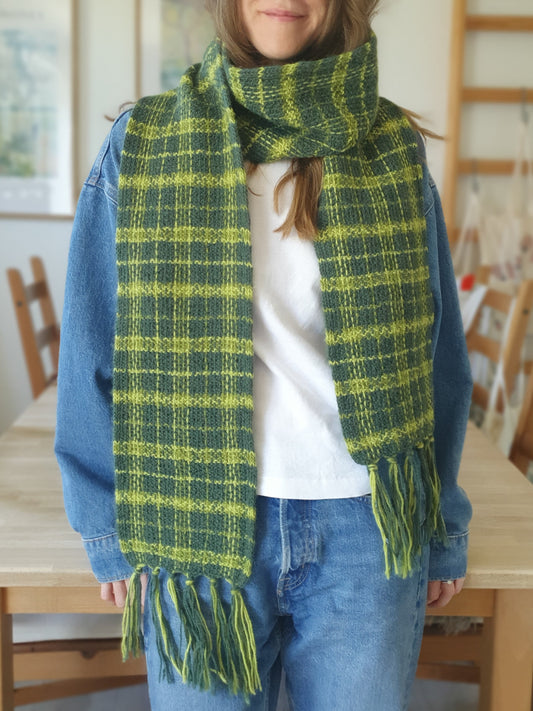
Isla Scarf
Regular price 35,00 DKKRegular price -
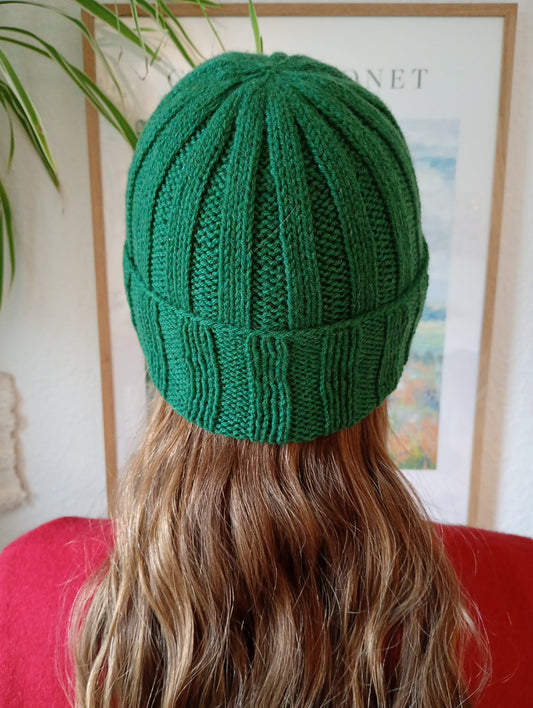
Charlie Beanie
Regular price 35,00 DKKRegular price -
Birgitte Beanie
Regular price 25,00 DKKRegular price -

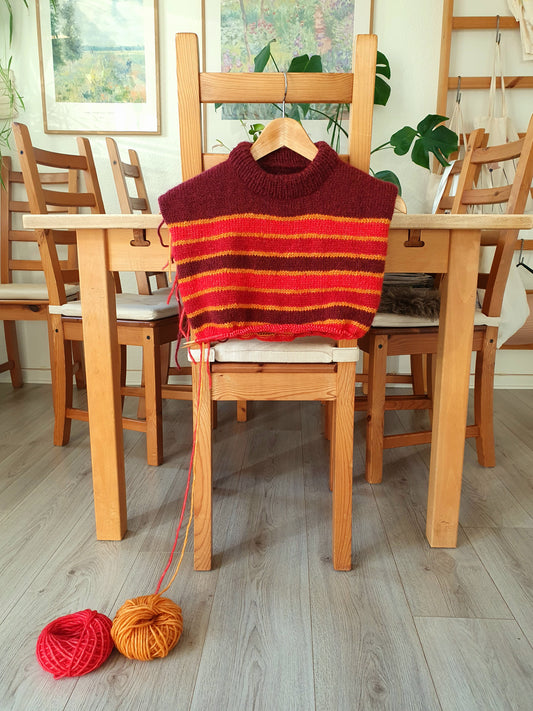 Coming!
Julie Sweater
Regular price 0,00 DKKRegular price